Sprezzatura: The Italian Art of Effortless Elegance

There is a man standing at the bar of a Milanese restaurant — a figure so casually composed that you notice him before you understand why. His jacket, an unlined cream linen, falls without ceremony from a shoulder that bears not a trace of padding. The collar of his shirt is open, the knot of a softly rolled knit tie hanging perhaps two centimetres below it. His trousers — high-waisted, cut in a stone fresco wool — barely graze the vamp of a pair of suede loafers. He has not tried. He has tried harder than anyone in the room.
This is sprezzatura. And if you have ever attempted to replicate that ease and found yourself looking either under-dressed or overdone, you have discovered its central paradox: the laidback look is the most demanding thing in sartorial culture to execute well.
The Codification of Nonchalance
The word itself arrives from Baldassare Castiglione, the Urbino-born diplomat and courtier who, in 1528, published Il Libro del Cortegiano — "The Book of the Courtier." Castiglione was composing a conduct manual for the Renaissance Italian court, but the concept at his work's philosophical core has outlasted every fashion cycle that has since come and gone. He described sprezzatura as the capacity "to hide all art and make whatever is done or said appear to be without effort and almost without any thought about it." The English translation loses something: "studied negligence" comes close, but it misses the weight of arte — the years of mastery deliberately concealed.
Castiglione's target was behaviour, not dress. But Italian style absorbed his philosophy into cloth. The Neapolitan tailors of the Via Chiaia understood intuitively what Castiglione had articulated in the court of Urbino: that the most powerful statement a dressed man can make is one that appears to have been made without deliberation. The English school, working from a different set of premises entirely, built a different argument.
The Italian Thesis vs. The English Theorem
Savile Row's contribution to menswear is architectural. A Huntsman coat, a Poole morning coat, an Anderson & Sheppard drape-cut jacket — these are garments in which structure serves the man. The canvas, the shoulder padding, the suppressed seams: all of it works to create a silhouette, to impose a geometry onto the body it inhabits. English tailoring operates from the outside in. It is an argument that form creates the man.
The Neapolitan counterargument runs in the opposite direction. The body creates the form. Houses like Isaia and Kiton — both rooted in Naples, that city of radical pragmatism and Mediterranean ease — build jackets that follow the torso rather than reshaping it. The canvas is lighter, often deconstructed. The shoulder is the signature: the spalla a camicia, or shirt shoulder, features fine shirring where the sleeve head meets the body of the jacket, producing small, deliberate pleats that allow the arm to move through its full range of motion without the shoulder seaming pulling or binding. The gorge line — the seam where the lapel meets the collar — sits higher and more open than its English counterpart, lending the chest an open, unguarded quality.
Brioni, operating from Penne in the Abruzzo rather than Naples proper, occupies a position between these philosophies. The construction is sophisticated and often more substantially canvassed than strict Neapolitan work, but the feel is always Italian — a garment that whispers authority rather than pronouncing it. To wear Brioni is to understand that power and ease are not opposites.
The choice between these traditions is not mere aesthetic preference. It is a question of what you want your clothes to say about your relationship to the rules. The Savile Row silhouette says: I have submitted to precision, and precision has rewarded me. The Neapolitan jacket says: I have so thoroughly mastered the rules that I no longer require them.
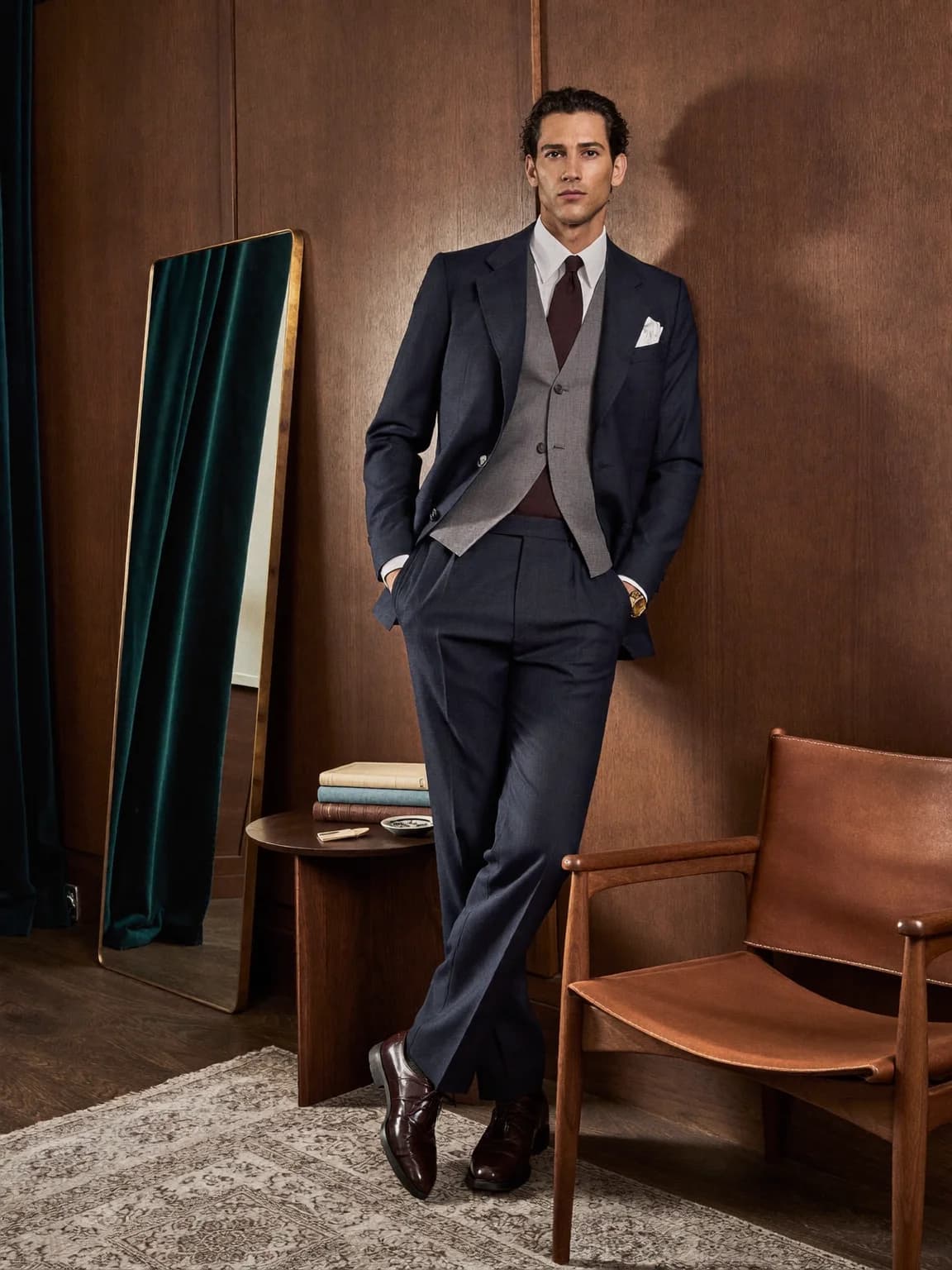
 The Milanese school in practice: two registers of the same philosophy — the structured black and the deconstructed navy — both arriving at ease by different routes.
The Anatomy of Studied Negligence
Understanding how to look effortless and elegant requires understanding the specific constructional choices that make effortlessness possible. Ease is not the absence of technique — it is the product of superior technique applied in the direction of liberation rather than restriction.
The jacket is the central document. A full-canvas construction, in which a layer of horsehair and cotton runs the full length of the front panel, is the structural foundation of any jacket worth the designation. In the soft Italian tradition, however, that canvas is frequently left floating — attached only at the edges rather than fused throughout, allowing the front panel to breathe and move independently of its interlining. The jacket lives with you rather than around you. Over months of wear, the canvas takes a precise impression of your particular posture and proportion; the garment becomes, in effect, a portrait in cloth. This is why a sprezzatura jacket cannot be bought in its final form. It must be inhabited.
The three-roll-two is a configuration of the button stance that Neapolitan tailors favour and that London increasingly acknowledges as correct: the lapel rolls naturally to the second button, leaving the third visible but functionally vestigial — it is never fastened. The roll itself, that soft three-dimensional curve of the lapel, is the product of hand-padding stitches worked by needle into the canvas, a process that takes a skilled tailor several hours. A flat lapel is a fused lapel, and a fused lapel is a garment that will never achieve the lived quality that sprezzatura demands.
The scye — the armhole — is cut high and closely set in Neapolitan work. A high scye allows the sleeve to drape cleanly without the body of the jacket shifting upward when the arm is raised. It is a detail invisible to the observer and transformative for the wearer, which is precisely the point. The sleeve itself ends at the wrist bone; on a jacket finished with Milanese buttonholes — those hand-worked closures distinguished by their characteristic gimp thread and the faint raised ridge it produces along the edge — the lowest button is left habitually open. An open sleeve button is not sloppiness. It is a declaration.
Pick-stitching along the lapel edges and pocket mouths is, contrary to how it is sometimes described, not purely ornamental. It holds the outer fabric and canvas together under the tension generated by a rolled lapel, distributing that tension along the edge rather than concentrating it at the padding stitches alone. That it also produces a texture faintly suggestive of hand-work is incidental to its function — and all the more elegant for it.
Cloth as Accomplice
The garments described above achieve nothing without the right fabric. Creating a laidback look is, at the level of cloth, a matter of choosing materials that participate willingly in the effect rather than resisting it.
Linen is the primary instrument. Its cellular structure means it breathes in heat, its open weave means it moves with the body, and its inevitable wrinkling — the quality that renders it anathema to those who conflate elegance with crispness — is precisely what makes it appropriate here. A linen jacket showing no evidence of having been worn is either unworn or ironed into submission, and ironing linen into submission is a category error. Loro Piana's summer linens, spun at the Biella mills from long-fibre flax sourced from Western Europe, are among the finest expressions of this material: soft enough to wear against the skin without a shirt, with a handle that improves visibly across a season of wear.
Fresco wool — an open, hopsack weave traditionally associated with warm-weather suiting — offers the year-round counterpart to linen's seasonal authority. Vitale Barberis Canonico's fresco cloths, woven in Pratrivero on the eastern slopes of the Biella valley, have a self-conscious roughness that reads as ease: there is no pretension to smoothness in a fresco weave, no ambition toward the mirror surface of a Super 180s. The cloth has texture, and texture signals that the man wearing it is comfortable in his own skin.
Ermenegildo Zegna's high-twist wools from the Trivero mills occupy a more technically sophisticated position. High-twist construction means the individual fibres are wound tightly before weaving, producing a cloth that resists creasing and recovers quickly from compression. A Zegna high-twist suit jacket can be folded into a carry-on bag, removed after a transatlantic flight, and worn at dinner without embarrassment. This is technical wizardry pressed into the service of sprezzatura — discipline concealed as convenience.
For shirting, the Albini Group's mills in Albizzate, near Lake Maggiore, produce some of the finest cotton cloth currently available. An Albini poplin in a soft ecru or pale blue — used by shirtmakers from Turnbull & Asser in London to the best houses in Naples — is the correct foundation for the open collar. The weave is fine enough to drape naturally when unbuttoned; it does not gap, does not spread unpleasantly, does not announce itself. It simply falls well. This is the correct aspiration for any material chosen in the spirit of sprezzatura.
The Vocabulary of Deliberate Imperfection
The technical infrastructure is necessary but insufficient. What transforms a well-constructed garment into an expression of Italian style is a series of small, intentional choices that read, to the uninitiated, as casual. Each is precisely calibrated.
The open collar. The question of how to look effortless and elegant is, in practice, frequently the question of what to do with one's collar. The answer, for the majority of smart-casual contexts, is nothing. The top button of the shirt is left undone. If wearing a tie — a knit tie, always, in this register; a woven silk introduces too much formality — it is loosened a centimetre, the knot sitting below the open collar without ceremony. The collar wings lie flat, neither pinned nor stiffened. A collar bar worn here is a ruinous miscalculation.
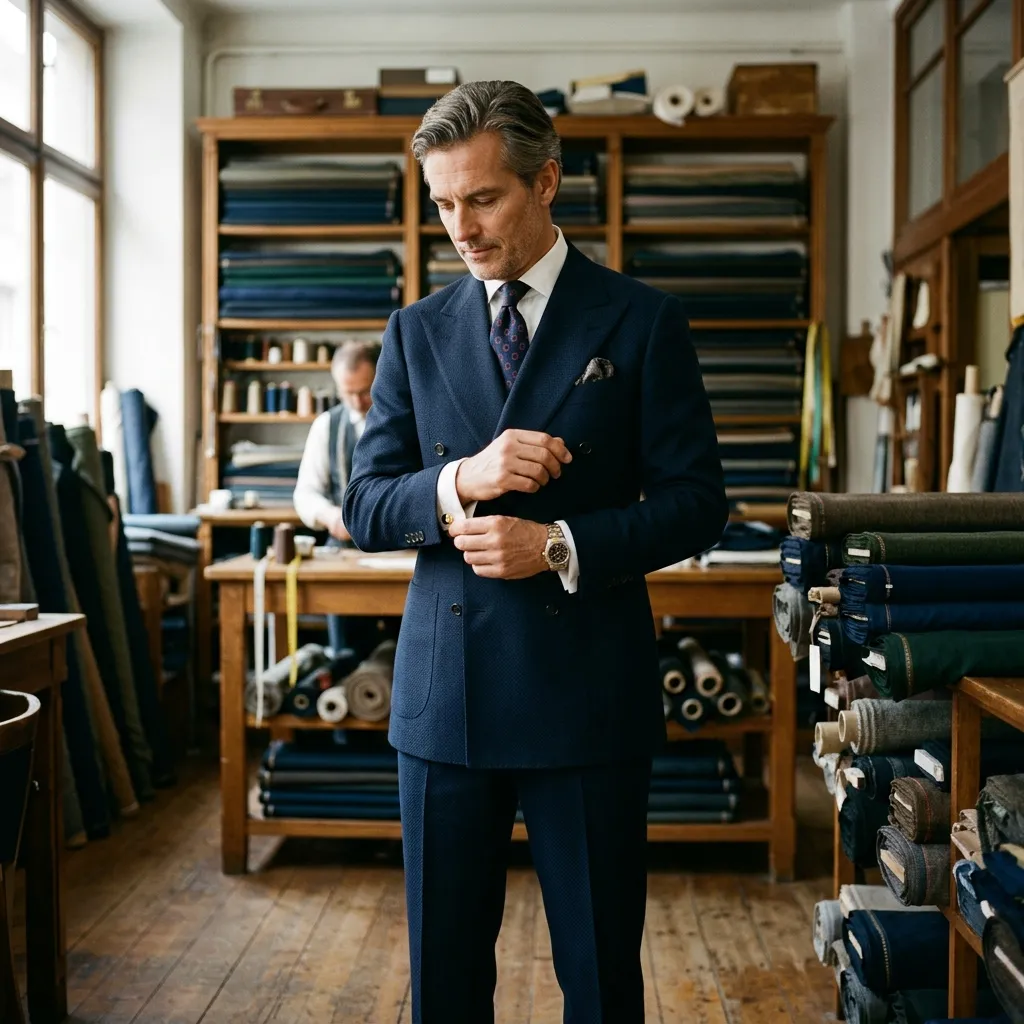
The pushed sleeve. Jacket sleeves in the soft Italian mode are frequently repositioned so that two or three additional inches of shirt cuff show, or so that the jacket sleeve itself sits fractionally higher than the wrist. This is not rolling in the American sense; it is a repositioning, almost unconscious in its execution. Neapolitan tailors and their clients developed this habit because the perfectly-placed sleeve felt studied, and felt studying is the thing to be avoided. The imprecision is the statement.
The pocket square. The television fold — that geometric presentation of four crisp and mathematically identical peaks — is the antithesis of the philosophy under discussion. It announces itself, draws attention to its own execution, and suggests that its wearer spent measurable time arranging it. The correct approach is the puff, the casual fold, or the loosely stuffed pochette whose edge shows slightly more of itself on one side than the other. The asymmetry is the proof of ease.
The trouser break. Proportional tailoring in the Italian mode favours either a slight break — the trouser hem barely touching the vamp of the shoe — or no break at all. The trouser and the shoe should read as a continuous vertical line, not as two garments negotiating their territorial boundary. On a loafer, no break is almost always the correct choice: the low profile of the shoe and the resulting suggestion of bare ankle signals the sprezzatura practitioner more immediately than any other single detail.
The Milanese buttonhole. On the working sleeve buttons of a soft jacket, the lowest is left open. It serves no functional purpose. It is, like the loosened knot and the asymmetric pocket square, a signal: I know how this works, and I have decided precisely how far to follow the rules.
 Each element conspires: the soft check jacket draped rather than worn, the tie allowed its own geometry, the sleeve revealing precisely the right length of cuff. None of it accidental.
Going Out in Style: The Modern Application
These principles are most visible in the context of an evening out — the territory where the distinction between a dressed man and a well-dressed man is most apparent, and where going out in style requires the sharpest calibration of intention and apparent carelessness.
For summer evenings in a city — dinner, a gallery opening, a late gathering at a bar that takes its cocktails seriously — the cream linen jacket is the correct starting point. Unlined, patch-pocketed, with a spalla a camicia shoulder and a three-roll-two stance. Beneath it: a spread-collar shirt in Albini ecru, a single button open at the collar, no tie. Trousers in a stone fresco wool, high-waisted with a slight taper from the knee and no break over a suede loafer in tan — Edward Green's Dover or a Gaziano & Girling equivalent. No pocket square that has been thought about at any length. The watch, if worn, should be understated: a Patek Philippe Calatrava, a Jaeger-LeCoultre Reverso, something that rewards close examination without demanding it.
For the shoulder-season context — autumn evenings, spring dinners — the navy deconstructed blazer in a hopsack or open-weave cloth becomes the pivot point. Worn with a white spread-collar shirt (again, no tie), flannel trousers in mid-grey, and either a tan Oxford or a double monk strap, it produces an ensemble that reads as considered without reading as formal. The formula is consistent: one element of obvious intention — the fit of the trouser, the quality of the shoe, the precise cloth of the jacket — and everything else apparently undecided.
The summer iteration requires the most commitment: the linen suit worn without a tie, with a loosely arranged pochette and loafers in white or tan. The suit must fit without being tight. The shirt must be open. If there is visible anxiety in the wearing of it, the effect collapses entirely.
The Discipline Behind the Ease
Sprezzatura's central demand is not aesthetic — it is psychological. The appearance of effortlessness requires that you have done enough work, owned the right things long enough, and worn them enough times, that the performance anxiety has entirely dissipated. A man in a new suit is always wearing a suit. A man in a jacket he has worn for five years is simply dressed.
This is why fast fashion cannot produce the effect. A garment that has not had time to take the impression of its wearer has not yet become an extension of him. The canvas of a quality jacket molds to the specific topography of the torso over months; the linen softens; the leather of the shoe creases in the precise places where your foot flexes. Time is the technique that no price tag can accelerate.
Castiglione understood this in 1528. The courtier who has spent a decade mastering the sword does not display that mastery by describing his training regimen. He displays it by picking up the sword and moving as though it were an extension of his arm. Sprezzatura is the sartorial equivalent: the concealment of years of attention beneath the surface of apparent disregard.
The laidback look, executed at its highest level, is not casual. It is the most serious thing a well-dressed man can do.